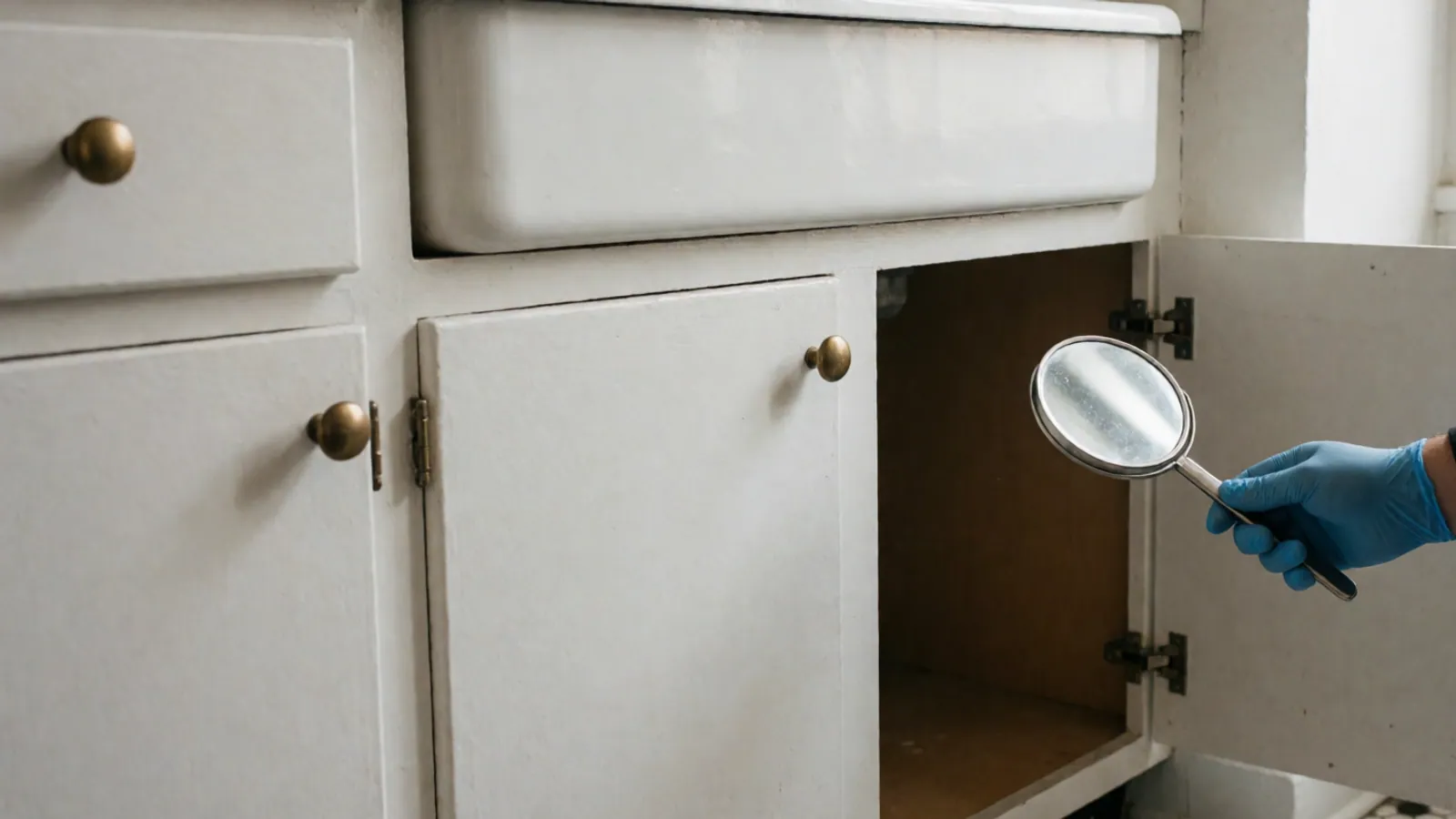
Inspection first
The inspection comes first, and it is mostly looking
What the pest is, how it gets in and what it lives on, found room by room and said out loud before the technician leaves.
AI-generated illustration. Not a real person, home or business.
Inspection first. Every job starts with an inspection. There's no charge for it, and you don't have to book anything after it.
A treatment chosen before anyone looks is a guess. The same small dark specks on a shelf could be cockroach droppings or mouse droppings; the work for the first is bait in the hinges and a second visit when the eggs hatch, and the work for the second is finding the hole behind the pipe and closing it. A spray put down before anyone looks scatters cockroaches into the walls and hides the very trail the technician came to follow.
An inspection of a home takes about an hour; of a building, a restaurant or an office, about an hour and a half; with termites, about an hour and a half.
What the technician looks at, room by room
With a flashlight, mostly, and on their knees for much of it. Nothing is treated on this visit.
The kitchen
The technician starts low. Cockroaches and mice both travel along edges, so the baseboard, the toe kick under the cabinets and the line where the floor meets the wall behind the stove say more than the counters do. German cockroaches want warmth and damp beside food: the hinge side of a cabinet door, the motor housing under a refrigerator, the back of a microwave. Their droppings look like ground pepper and gather where they shelter. Mouse droppings are larger, like grains of rice, and are scattered along a route rather than heaped in one place.
Under the sinks
Where the pipes come through the wall. The metal ring around a pipe is often loose or gone, and the hole behind it can run up inside the wall to the apartment above. In a prewar building it is one of the usual ways in for mice, and a corridor for cockroaches between kitchens.
The bathroom
The same pipes again, the space behind the toilet, and the wall behind the medicine cabinet, which in older buildings is often open to the void. A slow leak under a tub matters as much as anything alive: damp feeds cockroaches and softens the wood carpenter ants move into.
The bedrooms, when bed bugs are the question
The seams and tufts of the mattress, the corners of the box spring, the joints of the bed frame and the headboard, then outward: the nightstand, the baseboard nearest the bed, the edge of the carpet, the sofa if someone has been sleeping on it. What gives them away is small: dark spots like the dot of a felt pen along a seam, pale shed skins, sometimes a live one tucked into a fold.
The basement and the boiler room
In a house or a small building this is where pests come in from outside and where they spend the winter. The technician looks where pipes, gas lines and cables pass through the foundation wall, at the sill where the house sits on the foundation, at cardboard stored against the walls, and for the thin mud tubes termites build up a foundation wall.
The outside walls
A walk around the foundation: the gap under a door, a vent that has lost its screen, a crack where the sidewalk meets the wall, the garbage area, and the eaves and the fire escape for a nest. A burrow in the yard or a nest in a tree is pointed out too, with what we do and don't do about it.
What you hear before the technician leaves
You hear what we found before we leave.
- What the pest is, and how sure the technician is. Cockroach droppings and mouse droppings in the same cabinet mean two different jobs.
- How it is getting in, or whether it arrived another way. Bed bugs usually arrive in luggage, bags and secondhand furniture rather than through a wall, and German cockroaches as often in a grocery box as through a pipe hole. Each answer points the work somewhere different.
- What it is living on: the grease behind the stove, the bag of rice in a paper sack, the drip under the sink, the cardboard in the basement.
- What you can change before any visit, and what belongs to your landlord or a contractor rather than to you.
- Whether it is something we treat at all. If it is a squirrel, a swarm of honeybees or a nest in a hedge, you hear that now, before anything is booked.
Asked in person. The booking form asks nothing about who lives with you. At the inspection the technician asks about children, pregnancy, breathing conditions, pets and fish, because the product label decides who should stay out of treated areas and for how long.
Nothing has to follow
If there's work to do, the office sends an agreement: the course or plan, every visit, each visit's price and its tax, and how to cancel. You don't have to sign it.
What you learned is yours either way. You can take it to your landlord in writing, close the gap under the sink yourself, or keep the agreement in a drawer while you decide.
Before the inspection
Write down where and when you've seen pests or their signs, and show the technician.
Clear the space under the kitchen and bathroom sinks, so the technician can see the pipes and the back wall.
Make sure the technician can reach behind the stove and the refrigerator, or tell us if they can't be moved.
Unlock the basement, the boiler room or any storage the technician should see.
Don't spray or put anything down before the inspection: it hides where pests are going.
Tell the technician who lives there: children, anyone pregnant, anyone with a breathing condition, and pets and fish.
Start with an inspection
Book an inspection, at least twenty-four hours ahead. There's no charge for it, and nothing has to follow it.