A demonstration site — this company, its technicians and its customers are not real.
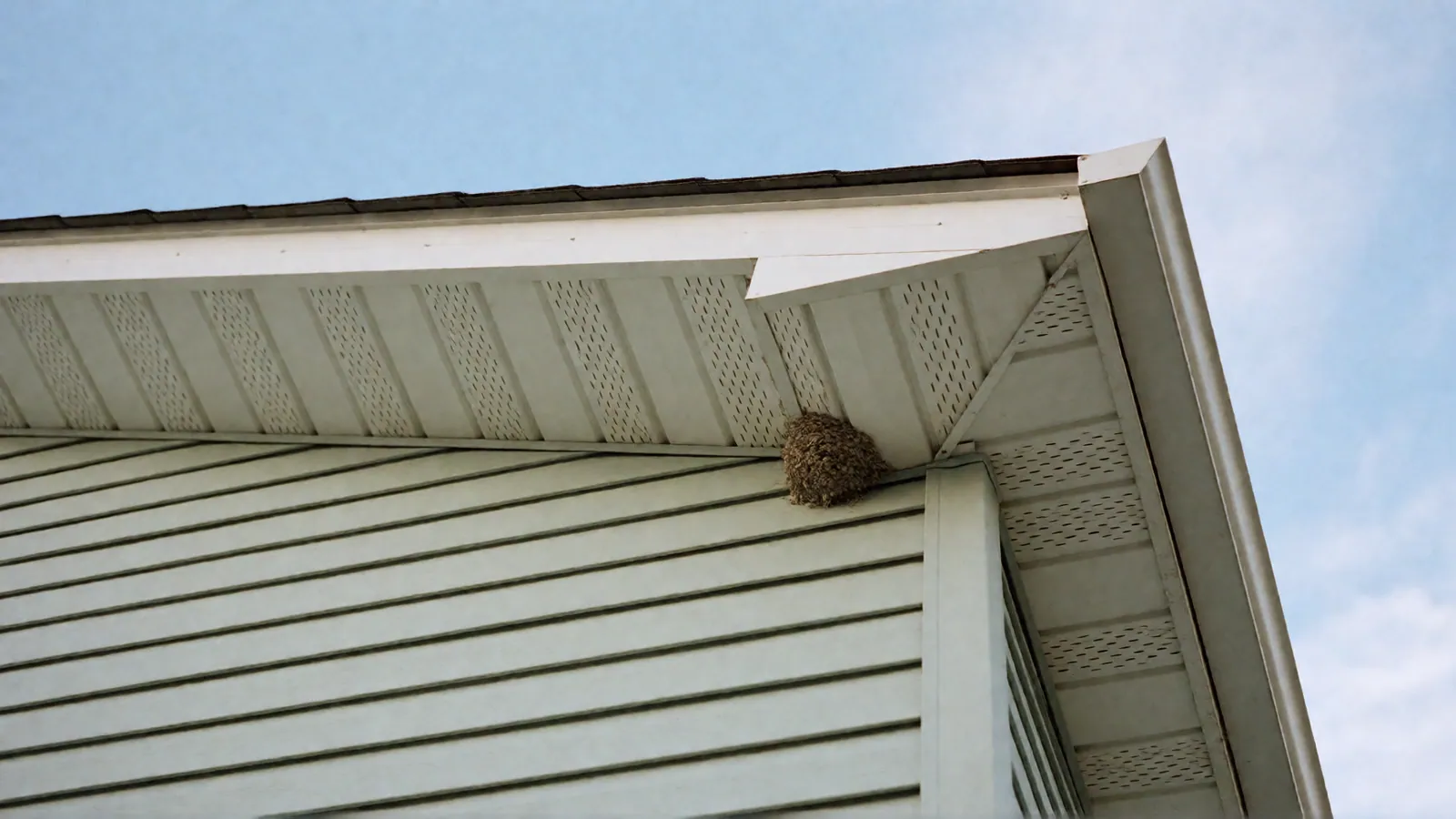
Seen from the ground, the corner of a house's eave with white soffit and pale siding, and one small gray papery nest tucked under it against a blue sky.

What we treat

Nests on the building, treated and taken down in two short visits

A nest on the eaves, a fire escape or inside a wall, treated on the first visit and taken down on a short second one.

  • A course, $224 to $376
  • Two visits

AI-generated illustration. Not a real home or business.

Wasp, hornet or yellowjacket, and where the nest is

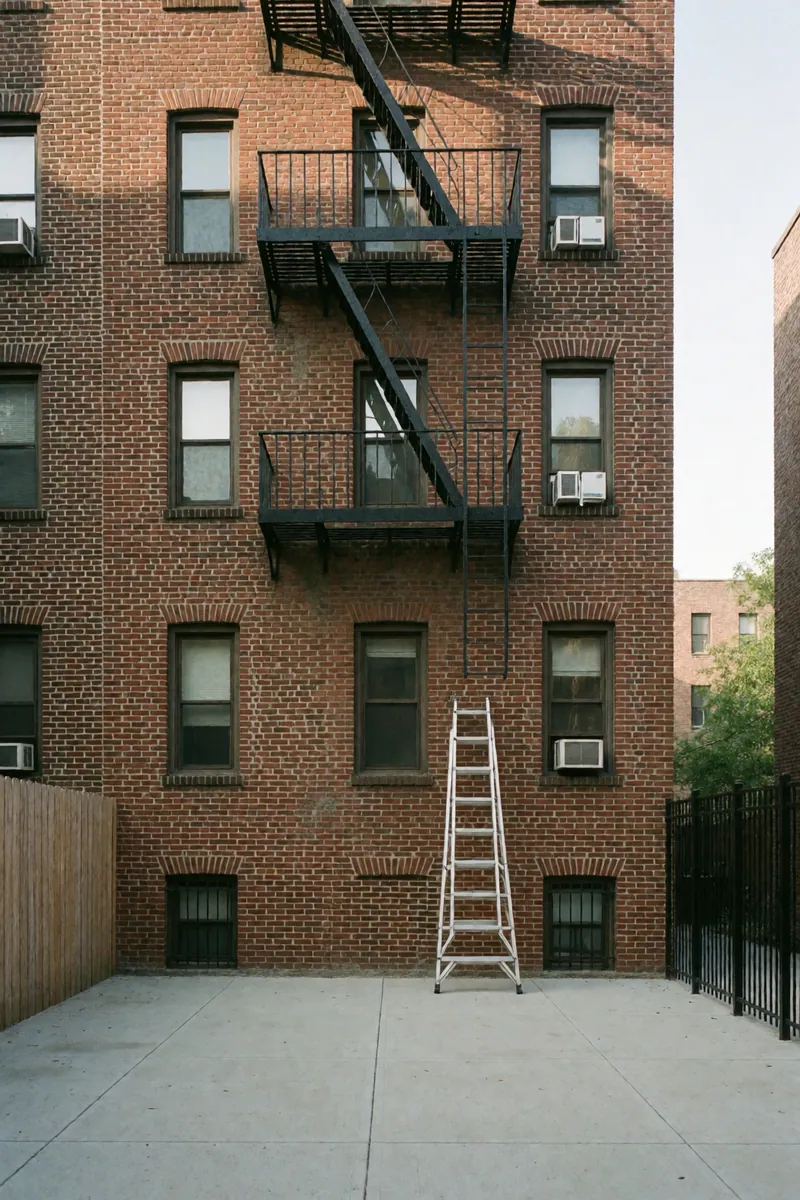
Paper wasps build an open, umbrella-shaped comb hanging from a single stalk: under an eave, on a fire escape landing, behind a window air conditioner, under a railing. They're slender, with long legs that hang down in flight, and they're the calmest of the three.

Yellowjackets are short, bright yellow and black, and nest out of sight: inside a wall, a soffit, a vent or a hole in the brick, with one opening you can watch them fly in and out of. By late summer the nest is large and busy, and they are the ones that come to a soda can at a picnic table.

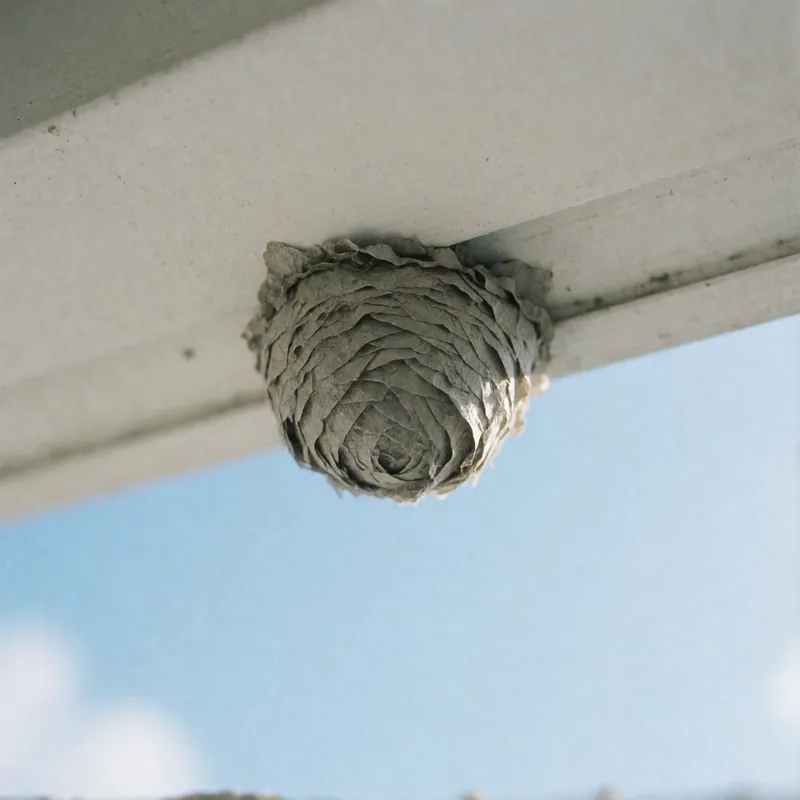
Hornets, usually the bald-faced kind, build the gray paper ball, most often in a tree or a hedge and sometimes under an eave or a porch roof. A nest in a tree, a hedge or the ground isn't work we do; a nest on or in the building is.

  • Nests in trees, hedges or the ground are lawn work under State rules, and we don't do it.
  • Honeybees are for a beekeeper.
Close view from below of a small gray papery nest, layered like folded paper, under a white wooden eave against a blue sky.AI-generated illustration. Not a real home or business.

What the inspection settles

Three things: that the insects are wasps, hornets or yellowjackets and not honeybees; whether the nest is on or in the building at all; and how it is reached. The course is priced by that last one, so the technician notes exactly where the nest is and how high.

A nest you can reach from the sidewalk or the yard, one that needs a ladder or a fire escape, and one inside a wall, a soffit or a vent are three different jobs, and the table below prices each.

Inspection first. Every job starts with an inspection. There's no charge for it, and you don't have to book anything after it.

The back of a red-brick apartment building with a black iron fire escape climbing its wall, and a closed aluminum ladder standing against the brick below it in a clean concrete yard.AI-generated illustration. Not a real home or business.

Hamid Sarwari-Quinn

Technician, buildings and businesses

Basements, trash rooms and the monthly round of a building.

Hamid keeps a building's visits in the same order every month, so the superintendent knows where he'll be.

Nests on a fire escape or under a soffit are his, with the ladder.

The course, visit by visit

Two visits, and every one of them is on the agreement, with its date, its price and its tax, before you sign.

  1. The first visit: a treatment

    At least twenty-four hours after you sign, so there is time for the preparation list, and for a home after your three business days to cancel unless you ask in writing to start sooner. It takes about forty-five minutes for a nest reachable from the ground, an hour for a nest reached from a ladder or a fire escape and an hour and fifteen minutes for a nest inside a wall, a soffit or a vent. The nest is treated at its entrance: for a paper wasp comb that is the comb itself, and for a yellowjacket nest in a wall it is the hole they use. An early window suits this work, while more of the nest is at home. A hole in a wall is left open after the treatment, because the wasps coming back have to pass through it.

  2. The second visit: a return to take the nest down

    Two days after the first visit, about thirty minutes. By now most of the wasps that were out foraging on the first day have come back through the treated entrance. The technician takes the nest down where it can be reached and, for a nest in a wall, a soffit or a vent, closes the hole they used.

Wasp nest course: a treatment and a return to take the nest down two days later. A course's price is split into equal parts, one invoiced after each of its scheduled visits, so you never pay for a visit that hasn't happened.
Where the nest isThe course, before taxEach of two partsTax on each part
Reachable from the ground$224$112.00$9.94
From a ladder or fire escape$324$162.00$14.38
Inside a wall or soffit$376$188.00$16.69

A return visit within seven days of the last scheduled visit is part of the course.

If they come back. If pests come back between visits, telephone the office. A return visit inside a course's return period, or at any time during a plan, is part of its price.

What you can do yourself

Keep away from the nest, and keep children and pets away from where the wasps fly in and out.

Don't knock it down, spray it, hose it or plug its hole. A yellowjacket nest with its entrance blocked often finds a way out through the inside of the wall, into a room.

Watch, from a distance, where they go in and out, and tell the office how high it is. That is what sets the price, and the ladder the technician brings.

A worked example, priced in full

Worked out with the same arithmetic as a real agreement: each visit's date, its share of the price and the sales tax on it. The household is invented.

A wasp nest on a fire escape An owner in Astoria

  • A treatment, Tuesday, March 9, 2027an hour; tax $14.38$162.00
  • A return to take the nest down, Thursday, March 11, 2027thirty minutes; tax $14.38$162.00
  • Before taxtwo visits$324.00
  • Sales tax (8.875%)on each visit's invoice$28.76
  • In allinvoiced visit by visit$352.76

Signed on Thursday, March 4, 2027. The three business days to cancel end at midnight on Monday, March 8, 2027, so the first visit is Tuesday, March 9, 2027, 7 am to 9 am. A return visit until Thursday, March 18, 2027 is part of the course.

Three days to cancel

Before anything is applied

What you're given before a treatment, and the lines this work doesn't cross.

Nests on the building only. We remove wasp and hornet nests on or in your building. Nests in trees, hedges or the ground fall under New York's lawn-pesticide rules, which need a separate written contract and notice to your neighbors, so we don't treat those.

Not honeybees. Honeybees aren't pests. For a swarm, call a beekeeper, and please don't spray it.

The label comes to you. We don't name products on this website. Before we treat, we give you the label information for every product we plan to use, including its warnings, on paper or by e-mail, whichever you prefer. After each visit you get a written record of what was used, where, and for which pest.

Staying out, and for how long. Before we treat, we tell you who should stay out of treated areas and for how long, exactly as the product label says.

A wasp or hornet nest isn't part of a monthly or quarterly plan: it's a course of its own.

Book an inspection for wasps and hornets

Book an inspection, at least twenty-four hours ahead. There's no charge for it, and nothing has to follow it.