Preparing for a visit
Before mouse and rat work
The sinks, the stove and the basement reachable, dry food in hard containers, and nothing of your own set out beside our traps: getting ready for mouse and rat work.
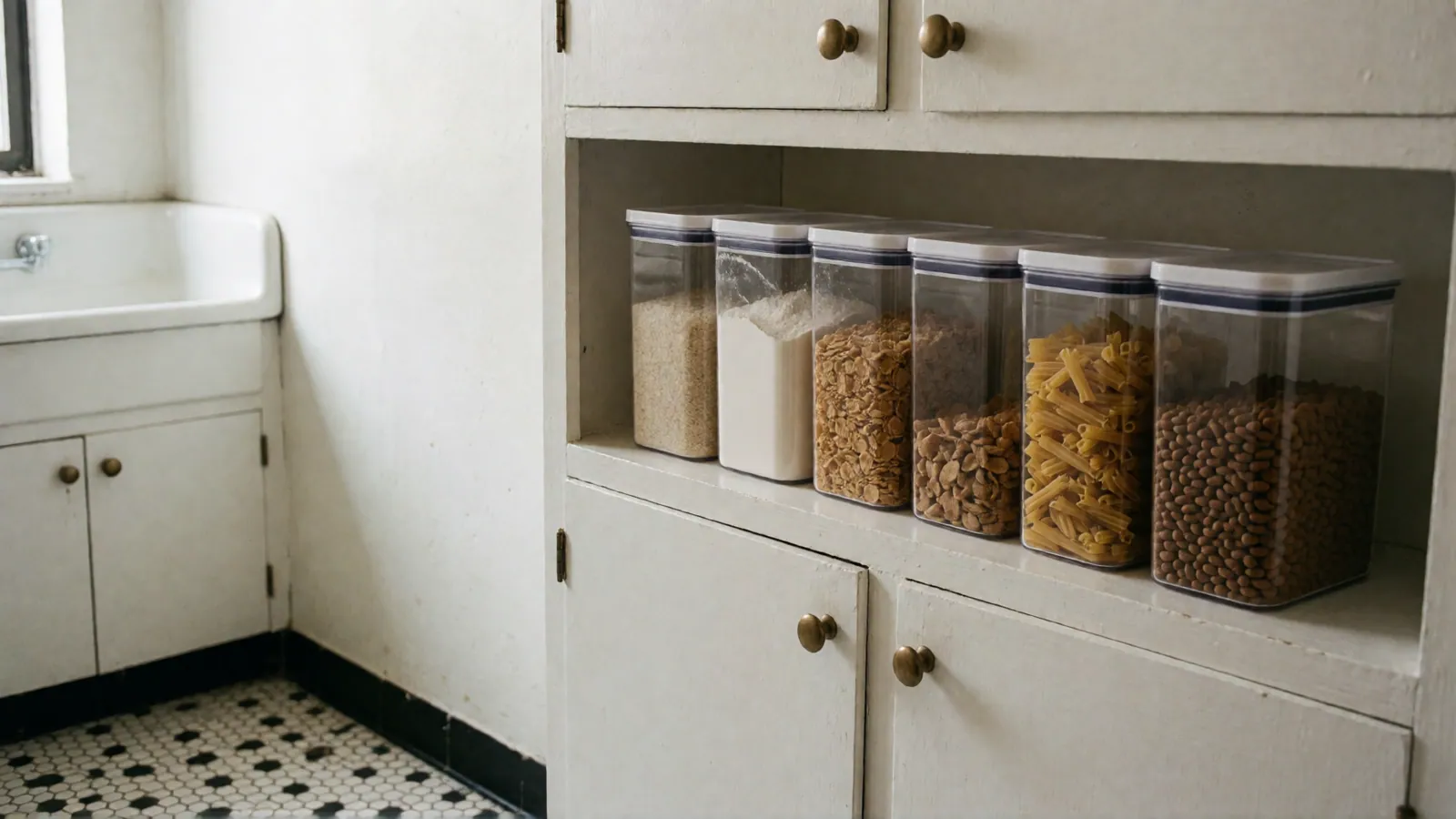
AI-generated illustration. Not a real home or business.
Why this list
Most of the first visit is spent finding how the mice or rats get in, so the technician needs to reach the places their routes run: under the sinks, behind the stove and the refrigerator, along the basement walls. Boxes stacked against a basement wall hide exactly the gap that matters.
Food goes into hard containers because a mouse goes straight through cardboard and plastic bags, and a trap is visited when it is the most interesting thing in the kitchen at night.
The list, item by item
Eleven things to do. Each visit comes with its preparation list, and this is the one for mice and rats, in full.
Write down where and when you've seen droppings or heard movement, and show us.
Clear access to the space under the sinks, behind the stove and the refrigerator, and to the basement and boiler room.
Move stored boxes away from the walls in the basement.
Put dry food, like cereal, rice, flour and snacks, and pet food into sealed hard containers.
Don't leave pet food out overnight.
Keep garbage in cans with tight lids, inside and outside.
Tell us about children and pets in the home, so every trap and station goes inside a locked box or out of reach.
Don't use store-bought poison or glue traps alongside our course.
Don't move or open our traps or stations.
Telephone us if you smell something dead, and don't handle a dead mouse or rat with bare hands.
Don't seal holes yourself before we've seen them: they show us the routes.
On the day
The first visit takes about an hour and fifteen minutes for any apartment and an hour and a half for a house. Tell the technician who lives with you: wherever children or pets can reach, every trap goes inside a locked box.
Afterward, don't move or open the traps or the stations, and telephone rather than handle anything you find. The second visit, a follow-up check, is one week later.
Small gaps, closed. During a visit we close small gaps and holes where pests get in, using sealant, mesh and door sweeps. Bigger repairs, like rebuilding a wall or replacing a door, are a job for your landlord or a licensed contractor; we'll tell you what we found.
The label comes to you. We don't name products on this website. Before we treat, we give you the label information for every product we plan to use, including its warnings, on paper or by e-mail, whichever you prefer. After each visit you get a written record of what was used, where, and for which pest.
We stop at the foundation. Outdoors we work only around the foundation, for pests that are getting inside: a band treated at the base of the wall, locked bait stations against it, gaps sealed. We don't treat lawns, gardens, trees or shrubs, and we don't spray yards for mosquitoes or ticks.
Where to go next
Start with an inspection
Book an inspection, at least twenty-four hours ahead. There's no charge for it, and nothing has to follow it.